Less is More: Multimodal Human Pose Estimation with Selective Fusion
Published in CVPR 2026 Findings: Proceedings of the IEEE/CVF Conference on Computer Vision and Pattern Recognition (CVPR) Findings
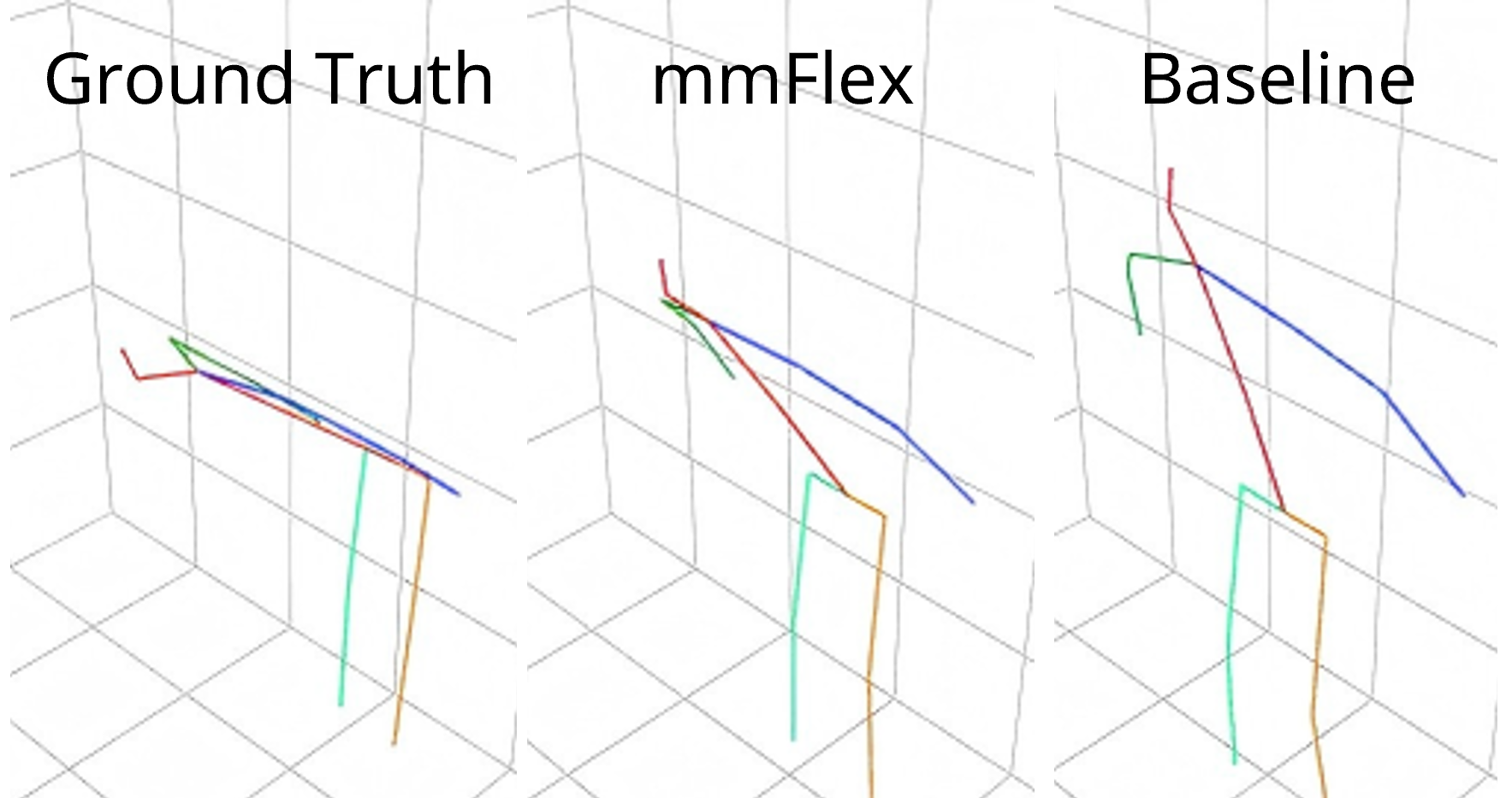
In this paper, we introduce FlexPose, a multimodal framework for human pose prediction that adaptively determines when fusion is beneficial and when single-modality processing is preferable. Specifically, we design an adaptive modality selection module that dynamically assesses inter-modal complementarity, allowing the model to revert to single-modality learning when fusion becomes detrimental. To further enhance robustness, we develop additional modules to handle missing modalities and to exploit temporal dependencies across frames. These designs collectively yield substantial accuracy improvements for human pose prediction. When evaluated on the MM-Fi dataset, our approach achieves relative improvements of 22.63% in MPJPE and 16.47% in PA-MPJPE over the baseline. Our code is available in https://github.com/xyt-fe/FlexPose_Modality_selection/tree/master.